A Domestic War of Words

The political debate in the U.S. has become so toxic that Democrats and Republicans can find it hard to be in the same room together. Congress and the media play their part in dividing the public. Some Americans do not want to accept this hyper-polarization as the new norm. Among them are the members of the group No Labels that wants to change the rules of conduct in Congress. In the audience of one of their meetings on the Hill, I met Kathryn Ruud who takes a private citizen’s approach to bringing the camps together. As a linguist she has studied the language the Nazis used in Germany and sees shocking parallels to today’s political discourse in the U.S. I attended one of her public talks about this topic in West Virginia and wrote about it in Financial Times Deutschland. Kathryn has published an English-language version on her website. Here it is:

A Domestic War of Words

Article by Sabine Muscat, Financial Times Deutschland, March 19, 2012.

The political debate in the U.S. grows ever more hateful. One woman is trying to stop it – with warnings from German history.

Kathryn Ruud still remembers the first time she felt worried about her country. Driving one day in the summer of 1992, she turned the dial of the radio to a station, and a new voice caught her attention, someone she had not heard before: In an agitated tone, the speaker insulted his political opponents, and called them “parasites”. To Ms. Ruud, these words seemed to come from another time. The now 60 year-old had studied linguistics at university in the German town of Trier, and she knew: this is how the Nazis in the “Third Reich” had spoken. But the voice she had tuned into on the radio was not that of a Nazi. It was that of Rush Limbaugh, one of the most popular right-wing radio entertainers in the U.S.

Back at her home, she climbed to the attic, and pulled a book from a box that she had brought back from Germany years ago. “Missbrauch der Sprache: Tendenzen nationalsozialistischer Sprachregelung” (The Misuse of Language: tendencies of national socialist language control”) by Siegfried Bork. She read it once again, and realized: talk show hosts like Limbaugh were employing similar methods. In the following years, she documented how extreme language began to seep into political dialogue in the U.S. – from the right as well as from the left. Last year the at-home mom and independent scholar decided she did not just want to analyze rhetoric, but rather become active as a traveling ambassador for civilized debate. To Ms. Ruud, political dialogue in the U.S. seemed to have reached a new low. “It is like a civil war, only the attacks are verbal,” she said.

Even though President Barack Obama had come into office hoping to unite the country, the political climate in the U.S. has become more poisonous than ever before. The right-wing Tea Party calls Obama a “fascist” as well as a “socialist”. The left-wing Occupy Wall Street movement agitates against “greedy” bankers. The media eagerly join the fray. Attacking from the front lines, yet again, is Rush Limbaugh. Recently, he called a Georgetown University student a “slut”, because she advocated that health plans of religiously affiliated institutions should include coverage for birth control. In this instance, at least, he apologized.

The language of polarization is not just a business model for media stars. Republican presidential candidate Rick Santorum regularly compares Obama’s America to Mussolini’s Italy. Democratic Representative Steve Cohen accused Republicans of spreading lies, “just like Goebbels,” about Obama’s health care reforms. As Democrat Gabby Giffords campaigned for re-election in 2010, the website of populist firebrand Sarah Palin posted a map marking Giffords’ district with crosshairs on a map. On the 8th of January, 2011, Giffords was severely injured in an assassination attempt. The shocked nation looked inward: Had rhetoric somehow prodded the mentally ill perpetrator to act out his fantasies? There seems to be no clear connection. But according to the Southern Poverty Law Center, the number of extremist “hate groups” in the U.S., organized against government, or blacks or gays, has now climbed to 1018.

In February 2012 Ruud stood in Martinsburg’s Good Natured Market and Vegetarian Café in rural West Virginia. A white sheet on the wall served as the screen surface for her PowerPoint presentation. About 20 listeners of all ages sat at bistro tables. They wore knitted sweaters and pullovers. Most of them were participants in Occupy Martinsburg, a local offshoot of Occupy Wall Street. Ruud, who lives in neighboring Maryland, has given her talk to college students and religious groups throughout the region, and she has also discussed her topic with Tea Party supporters.

With serious faces, the audience listens, as the speaker appeals to reason. “We can all live in the same country without killing each other. This is a great country, but it would be much better, if we could deal with one other in a civilized way,” she says. To demonstrate the source of her concern, Ruud gives examples from history, from the language of fascists and communists. She argues that both extremes exploit stereotypes and propaganda that twist the meanings of words and denigrate opponents through derogatory language.

Ruud shows short videos in which right- and left-wing talk show hosts label opponents “parasites” and “vermin”. Ruud says that in Germany today, it is unimaginable that someone would say such things in public. But in the U.S., this historical experience with dangerous demagoguery is missing.

Most of her examples are from right-wing talk radio shows, as these dominate over left-wing programs in both air time and intensity. But Ruud does not let the other side off the hook. She makes clear that Germany has experienced not just Nazis, but also the Red Army Faction, a left-wing terrorist group that kidnapped and killed prominent business figures uring the 1970s.

“Wall Street bankers are maggots,” says Ruud, an example she uses to test the audience. “Which word dehumanizes?” she asks. “The word Wall Street”, says one participant, as others laugh. Another one sounds more serious. “It doesn’t matter if it is the left or the right,” he calls out. “The truth is that all of us are being screwed by those at the top!” And so a new enemy has been identified. The self-appointed ambassador for civilized debate has much work yet to do.

Posted in Americana | Tagged , | Leave a comment

The Mormon Way

Bill Marriott drives himself to the interview at the Marriott Suites in Bethesda, just outside of Washington, DC, and he declines help with his coat. But when it comes to having his picture taken, he issues clear instructions: No photos sitting down! He prefers a standing pose – crossed arms, shining cufflinks – just like the photo in his office, which shows him with his late father, the founder of the Marriott hotel empire. Modesty and a sense of tradition define the son, who at almost 80 is now the patriarch himself. His inner driving force is his religion. Marriott is Mormon, and he believes that his faith is the basis for his success in business.

The Presidential candidacy of Mitt Romney is shining a spotlight on his religion – and on other famous members of the Church of Jesus Christ of Latter-day Saints. Like the Romneys, the Marriotts are one of the first Mormon families in the U.S. Bill Marriott is an important donor for Romney’s campaign – just like his father had supported the failed Presidential run of Romney’s father George in 1968. He agreed to talk about his faith to Capital magazine. Erika Larsen captured a glimpse of his strict yet mild personality in her photos.

© 2012 Erika Larsen

The story of the Marriott family is an American pioneer story. They settled in the arid plains of Utah. Bill Marriott senior moved to Washington, DC in 1927 where he started what is now a global business with a Root Beer stand on 14th Street. His son claims that the Mormon teachings of hard work, self-subsistence and strong family values made it possible to live the American Dream. Other successful Mormons agree. Harvard Business School professor Clayton Christensen believes that his famous theory of disruptive innovations does not only apply to technologies like the iPad, but also to the Mormon religion, which, in his mind, at its founding in the 19th century, revolutionized Christianity in a similar way like Martin Luther.

Many Americans refuse to see it that way. They are suspicious of a religion that has amassed an enormous undeclared wealth, performs proxy baptisms for the dead in temples that are closed to the public, and sends young men abroad as missionaries for the church. In Bill Marriott’s view, Mitt Romney’s candidacy is an opportunity to change the perception of Mormonism as a secretive cult. “A Mormon President would allow us to step out of obscurity,” he says. “We want to become mainstream.”

Posted in Americana | Tagged , , , | Leave a comment

Letter from China (9): The World of Avatar

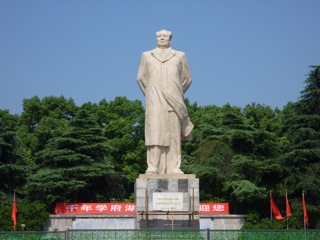
China for me has always been Hunan. The beautiful campus of Hunan University at the foot of the Yuelu Mountain with its famous Yuelu Academy. The rice terraces and the peasant life in Xiangtan County. Stinky tofu on the streets and red hot chili peppers in every meal. The Yueyang Pagoda with the backdrop of Dongting Lake. And the red earth house in Shaoshan, where Chairman Mao was born.

Chairman Mao still looms large at Hunan University

But I have never been to Zhangjiajie. For most people, the rock and tree formations of this region are the main reason to visit the province in central China. I missed the opportunity to go there on previous visits – and now my friends tell me that it is too late. “Too touristy. You can’t go there anymore.” But then my friend’s sister makes the decisive argument: “You should go. The mountains, after all, are still there.”

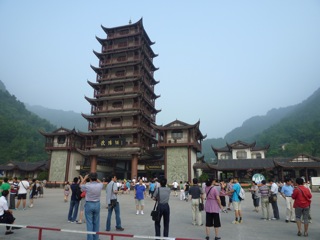
So we go, two Germans and one Chinese with a German passport. We get the first flavor of modern Chinese mass tourism upon our arrival. The brand new train station of Zhangjiajie town looks like an airport terminal, and Asia’s longest cable car (7000 meters) is already visible from here. After a 30 minute cab ride, we arrive at our hotel in Wulingyuan. The village is close to the main entrance gate into the National Park, and it is so packed with tour buses and honking cars that it is a challenge to cross the street.

Our first stop is the travel agency – we are here for hiking and we don’t want to waste time. The young woman at the agency suggests a route: “We can go up by cable car to visit the sites in the Eastern part. After lunch, the environmentally friendly bus will take us to the Western side, and in the evening, we take the elevator back down.” Indeed, Zhangjiajie, as far as I know, is the only place in the world where they have built an elevator into the mountains.

We explain that we would like to hike up to the top. The travel agent shakes her head: “No, that is very strenuous and very dangerous.” She would not recommend it. We argue with her for half an hour and then we ask her to find a local peasant to be our guide. The first person she calls doesn’t want to be responsible for three crazy foreigners. The next guide agrees to take us on.

Mr. Peng meets us at the big gate. He wears orange plastic sandals and a straw hat. We pay 247 Yuan per person for a two-day pass and get in line at the entrance where they take our fingerprints. We start hiking on a well built stone path in the forest and continue on the typical stairs, which the Chinese hew into all their mountains. I notice that Mr. Peng walks them up in zigzag – it is better for the knees.

The forest is lovely and everything is peaceful for an hour, before we meet the first people coming downhill. “Look, foreigners,” they comment. “And they are hiking uphill!” After a few more turns, we have caught up with the masses at the first viewpoint. Cameras are clicking, people are shoving and pushing and tour guides are shouting into megaphones. Vendors sell little wooden carvings, stitched bags and purses, jade bracelets, postcards, hats and hiking sticks. And wherever there are Chinese tourists, there has to be greasy food on sticks: deep-fried tofu, sausages, whole quails and fish. In Zhangjiajie, they also sell local cucumbers as refreshment.

It is not quite what we had hoped for. But my friend’s sister was right: The mountains are still here, and they are spectacular! We accept the fact that there won’t be much hiking, pull out our cameras and start clicking away. We let Mr. Peng explain the rock shapes: a “Fairy with a flower pot”, a “Heavenly Chair” or “Zhubajie carries the old lady” (Zhubajie is a character in the novel “Journey to the West”). Then, without much protest, we get on the “environmental bus” (which runs on a diesel engine) to get to the other side of the mountain range.

This area claims to be the place, which had inspired the production team of Avatar, last year’s 3-D box office hit by James Cameron. We see the mountain which looks as if it is floating, at least if clouds cover its bottom half. Cameron’s producers had visited the area, but when the director himself came to China to promote his movie, he mistakenly referred to the internationally much more famous Yellow Mountain as his model. The resort management of Zhangjiajie created a crisis task force and launched a desperate ceremony in which they renamed the rock which was previously known as Southern Sky Column into “Avatar Hallelujah Mountain”.

As we take the glass elevator down and listen to the announcements in Chinese and Korean, I have my doubts whether better marketing would have attracted more international tourists. Zhangjiajie is not on the way for typical China round-trips. And it is not equipped to deal with guests like us. In the evening, we try to order a glass of wine in the bar of our five-star hotel, and the waitress says: 没有 (We don’t have that.) Only after we complain to the management she produces four bottles for us to choose from. We rule out the 1200 Yuan Baron de Rothschild Bordeaux and settle for a Chinese Changyu, which turns out to be a nice light red, similar to a Cabernet Franc.

The next day, we tell Mr. Peng that we don’t need him anymore. We still have not given up on the idea of hiking. This time, we start our tour with about 4000 other Chinese tourists alongside a little creek. After half an hour, we adventurously take a left turn into the forest. In one instant, we find ourselves hiking up a mountain stairway in complete solitude. The steps are very steep and we cannot drink as fast as we sweat in Hunan’s damp heat – which has the advantage that we never have to use the bathroom. The forest is full of miracles: monkeys and fat toads, butterflies and kiwi trees. When we reach the top after two hours, we are exhausted but happy.

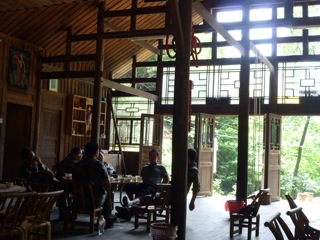
To our surprise, we come across a cozy log cabin with a little restaurant, in which a few locals are playing cards. They are wearing used military uniforms, a common view in China’s rural areas. We buy more water and take a rest, and then we notice the postings that other visitors have left on the wall – in German, English, French, Spanish, Dutch and Czech. “We ran out of water two hours ago”, someone complained. But in the end they all agreed that it was wonderful to have a peaceful day away from the masses.

Having left our own message, we hike up a loop trail – and end up opposite the spectacular Avatar rocks. This time, we have them all for ourselves. The views are breathtaking and if you ask me, they even beat the Grand Canyon. The battery of my camera is empty by the time we start to walk downhill. This path too, is not for beginners. We almost get lost twice and we have to climb across two collapsed wooden bridges towards the end. But we managed to get a day with six hours of straight hiking while running into not more than five other travelers.

In the evening, we fight to order a glass of whiskey at our hotel bar. After we have persuaded the management to let the intimidated waitress pour us each an ounce of Johnny Walker Black Label, we toast each other on our successful hiking day. Zhangjiajie is definitely worth a visit – just don’t follow your Chinese tour guide.

Posted in Letter from China | Leave a comment

Letter from China (8): Changsha Unplugged

Hunan’s capital Changsha is famous for its wild nightlife nowadays, but I had not expected that having dinner with a businessman, his freshly married young wife and some of his employees on a Tuesday night would throw me in the midst of it.

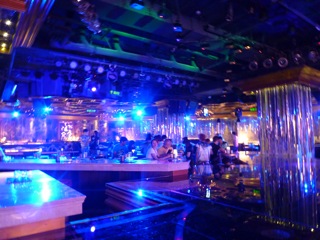
“Let’s go to a bar,” suggests Mr. Zhang, who runs a private accounting school. He pays for our dinner, and after that we all get into his car and drive a few blocks to West Jiefang Street. The silver Honda glides into a sea of red, pink, and yellow neon and I realize that this must be the “Strip” of Changsha. We pass places with names like Coco Club and Soho Club – then we are stuck in traffic. There is no way to turn and no place to park the car. We might as well get off and hand the keys to the valet boys of the “Club Me!”. We climb up the stairs and delve into a world of velvet, strobe lights and techno beats.

We are early; it is only 9 pm. We settle around a bistro table and a girl in a sexy little black waitress outfit comes to take our orders. The menu offers whole bottles of Hennessy VSOP and other liquors for 1200 Yuan upwards, a batch of 12 bottles of beer costs 800 Yuan. We manage to order half a portion – six bottles for 400 Yuan.

“We used to come here a lot as students,” says Mr. Zhang’s lively wife who is twenty years younger than him. With her blue and white baby-doll dress, big round eyes and a ribbon in her hair, she looks even younger than her age of 25. “How can students afford this?” I ask incredulously. She gives me a sweet but slightly wicked smile: “We always knew some people who were doing things here.”

Along with the beer, the waitress brings popcorn, watermelon cubes and fried chicken feet to snack on. Every table is equipped with two sets of dices in silver cups and we play with them to pass the time. Out of the corner of my eye, I watch the place fill up with a bizarre mix of visitors. Some just wear jeans and t-shirt, but they mingle with girls with super-tight skirts, young men with asymmetrical haircuts and thick-rimmed designer glasses. Two gay men are holding each other tight on one of the lounge sofas for which you need a reservation. All age groups are represented – the people at the table next to ours have even brought their little boy.

By 10 pm, the place is packed and the show begins. A girl with cropped red-colored hair swoons into a microphone. She is wearing blue leggings with white stars and a shirt with red and white stripes. At first, I don’t pay much attention to what seems to be a typical Chinese Karaoke performance. But after the American flag girl leaves the huge stage in the center of the room, things start to get more interesting. A group of handsome Chinese men presents the latest metrosexual fashion: Michael Jackson meets Star Trek, with a lot of zippers. The next attraction is announced as “beautiful girls from foreign lands” – a group of Russian blondes and black women in bikinis parade in front of the gaping audience. I am told that they are prostitutes, and that the black women are from Zimbabwe. None of them have legal residence status, but the politically well-connected club owners are powerful enough to protect them.

Now it is time for the audience to get involved. The first “beautiful woman” who dares to come upstage is awarded a pink teddy bear. When the moderators ask for a “single young man” to step forward, my neighbors push their little boy on the stage. The audience is raving with amusement. “Do you have a girl-friend?” the moderator asks the 8 year old boy. “Mei you,” he says, “I don’t.” This should meet the criteria, but before he gets the white teddy bear, he has to answer another question: “How much is one plus two plus three plus four?” “Ten,” says the boy. Even in a nightclub, Chinese children have to be prepared to pass a test at all times.

The bartenders now toss neon sticks into the crowd and we wave them through the dark to cheer on the next performer: a rock singer wearing white cowboy boots over white denim jeans, paired with white leather gloves and a red shirt. He raps a medley of old Communist songs and the audience screams along. Between songs, assistants hand him glass pitchers full of beer, which he downs fearlessly. I notice that his listeners are not far behind: A few young men at one of our neighboring tables drink all their bottles in one gulp.

This is probably what you need to prepare yourself for the highlights of the show. The next program is a “fairy tale” in which a prince has to kill a demon to liberate a half-naked mermaid who frantically flaps across the stage while good and evil fight over her. After that, a woman with wild hair and a Chinese Tarzan with a ponytail and a black leather thong perform a pole dance to the sound of the German techno formation Rammstein. The woman remains on stage and is joined by a chubby man who poses as a regular guy from the audience. She chains him to a chair, strips him almost naked, pours ice cubes in his underpants and teases him with a black leather belt.

I take a look around to see what our neighbors are up to. The beer drinkers are swaying back and forth by now and I wonder how and if they will make it home tonight. On the other table, the 8-year-old boy has managed to open a bottle of Hennessy VSOP, but his parents snatch it from him before he can take a sip. The gay couple on the sofa is getting busy. When we leave around 11, it looks as if the party is only just beginning for the newcomers who are still streaming in.

As we wait for the car, I ask my local companions if all the bars in Changsha are like this. “Pretty much,” says Mr. Zhang, “We are a bit more open than people in Beijing or Shanghai. And on the weekends, people from Guangzhou take the fast-speed train up here to see our nightlife.” His wife gives me an curious look and asks: “What do people in Germany do when they want to drink a beer?” Mr. Zhang answers for me: “I guess they just go somewhere, drink a glass of beer and then go home.”

Posted in Letter from China | Leave a comment

Letter from China (7): Happy Valentine’s Day

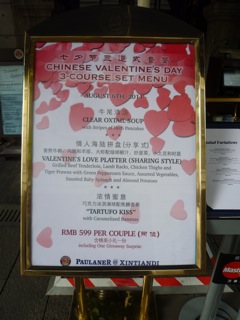
I was supposed to meet someone at Xintiandi, the part of old Shanghai that has been resurrected for tourists. While I was waiting between the cute little brick houses, I took a look around the shop windows and restaurant menus, until the entrance of the Munich brewery Paulaner caught my eye. In front of the door, a young Chinese man clad in Lederhosen stood at attention next to a big white sign with red hearts floating all over it. „Chinese Valentine’s Day“, it said. „3-course set menu“. I was surprised: First of all I had never thought of Paulaner as a romantic venue – and then: Wasn’t Valentine’s Day in February?

Image

The Chinese Bavarian explained it eagerly. „There is an old story in China“, he began. It is a story about two lovers, a heavenly fairy and a farmer’s boy, who were allowed to meet only once a year, on the 7th day of the 7th month of the lunar calendar, which happens to be on August 6th this year. If you ask around, not many people older than 35 had previously ever heard of this day. For years now, China has been sticking to the Western date for Valentine’s Day, February 14th. But of course this is not satisfactory for this proud culture with thousands of years of history – and the potentially biggest consumer market in the world. So it only makes sense that China now has two days a year, on which young men are expected to spend money on their sweethearts.

This also means that it has two days to make singles feel miserable. In the U.S., Valentine’s Day is certainly the day where you better have a date – or die. How much worse must the situation be in China, where being single past the age of 30 already means you are a 剩女, a left-over woman. „Sex and the city“ was a popular TV show here as well, but just as popular was the Japanese format 败犬, „Failure dogs“, another not-so charming expression for a bachelerette.

As in the West, the women who have a hard time finding their 白马王子, their prince on the white horse, are the professional ones with a high salary and good career opportunities. And as in the West, the debate is over whether the fault lies with the men who just can’t accept a successful woman or whether the women have unrealistic expectations towards the men.

On my second day in Shanghai, I meet a therapist who thinks that first you have to create opportunities for these women to meet men. “Many just go to work and back, they don’t have a private life”, she tells me. She sends her patients to salsa classes – undercover, if you will, since only the dancing instructor knows who they are, and I, the secret observer for one evening.

At around 6.30 pm, the first students amble into the studio. It doesn’t need explaining who the dating students are. They are not the glamorous looking women, dressed in tight pants and shirts with bare backs who come in groups of two and gossip about men. They are the ones who have come alone. There is the tall girl in a business outfit, a black skirt and a blouse with blue and white stripes; her hair is neatly pulled back to form a bun. Another one is slightly chubby, but she wears shorts and a shoulder-free shirt, for her salsa shoes she went for blue and black glitter.

The class begins at 7 pm. The teacher turns on the music, a salsa song with Japanese lyrics, and starts swaying his hips in front of the mirror; his students try to sway with him. The chubby girl has a good sense of rhythm, but the woman in the business dress has problems, and it is not clear whether her tight skirt is the reason or her lack of coordination. When she tries to raise her hip, the whole leg goes up, she looks like a stork wading through high weeds.

When it is time for everyone to find a partner, the women with the bare backs and long legs draw the men into their orbit with one flicker of the eyelid. The dating students are left over, but then the teacher intervenes and makes new arrangements. The office stork lands in the arms of a blond foreigner with two left feet, who grabs her clumsily around the hips. But who knew? A few beats into the song, she smiles for the first time, and the foreigner seems quite engaged as well. I see them exchanging words and cracking a joke.

I will leave them here, but if they asked me for my advice on where to go this Saturday, I could recommend Paulaner at Xintiandi: Oxtail soup, Valentine’s Love Platter (sharing style) and Tartufo Kiss, all for RMB 599.

Posted in Letter from China | Leave a comment

Letter from China (6): A Train Wreck

I am in Shanghai, but I did not come here on the new high-speed train. Not that I didn’t try. I tried to book a ticket online and I tried to buy it in person from the little train ticket office in my neighborhood. Those efforts were thwarted by a new rule, which stipulates that foreigners can only buy tickets at the train station. For someone like me, who has neither an office secretary nor a hotel agent at their service, this would have meant spending most part of a day traveling to Beijing’s South Station to show them my passport. Forget it.

I had already booked a flight when I received an email from a Chinese friend: “Sabine, have you booked the train ticket? I think you should be careful about taking fast trains.” On July 23, a high-speed train had rear-ended another one near the city of Wenzhou, killing at least 40 people. The incident has triggered a virulent debate in China, which is symptomatic of the deep distrust people have towards their non-elected officials. At the same time, it has also shown how difficult it has become to keep people from making this distrust openly known.

There was enough to be angry about. The operator tried to remove evidence and waited a whole day before giving its first press conference. A two-year old girl was found alive in the wreckage after the operator had declared that there were no more survivors. The government tried to block reporting about this story, but even state-run papers and TV channels defied this order while the microblogs, the Chinese version of Twitter, were overflowing with speculation about mismanagement and corruption that might have led to the overly speedy (and sloppy) construction of the high-speed trains, especially since signal failure was a likely cause for the disaster.

The episode is more than an embarrassment for the government. China’s homegrown high-speed trains are feted as another step on the way of the country’s high-speed transition into a modern nation. And the prestigious new line that cuts the travel time between Beijing and Shanghai to four hours started operating on July 1st, the 90th anniversary of the Communist Party.

On July 5th, a video in which a giant Kung Fu panda proposed to his girl-friend on the Jing-Hu train (short for Beijing to Shanghai) became an instant success on Youku and Tudou (the Chinese equivalents of Youtube). A few days later, a friend texted me from inside the train and raved about how comfortable it was. His only complaint: He caught the train conductors smoking in the instrument room. At least they apologized profusely when they were called out.

But very soon, the train ran into problems. There were reports about delays and about passengers left boiling in train cabins with no air conditioning. There were reports about technical flaws. The airlines, which had lowered their prices to compete with the train, regained confidence and raised them to their previous levels. The train wreck of July 23rd should have quelled all remaining worries for carriers flying between China’s most important cities.

What is hasn’t quelled are the concerns of citizens who are increasingly edgy. They worry about tainted baby food and fake medicines; they worry about collapsing bridges and crashing trains; they worry about losing their homes to urban development. And most of all, they worry that the same problem lies at the bottom of all these flawed products and procedures: corruption.

To bribe and to be bribed has become the way of life in China. The local government gets paid off by the development company to take away your home. The doctor is bribed by the pharmaceutical industry, just like everywhere else in the world. But in China, you better give that doctor a hongbao (a red envelope with money) too, if he is going to perform surgery on you. You even bribe the teachers if you want them to pay attention to your child’s education. It seems as if this phenomenon has become more pervasive in recent years.

This makes me wonder whether I could have bribed the woman at the ticket office into selling me a train ticket to Shanghai?

Posted in Letter from China | Leave a comment

Letter from China (5): Crazy Bad Air

Summer can take very different forms, depending on where you live. In Berlin, you might want to check the weather forecast before leaving the house to see if you should bring a warmer coat, even in July. In Washington, you watch out for storm warnings since you don’t want to get trapped in some tropical hurricane on the way back from work. In Beijing, you check the air quality.

Upon my arrival in early July, I was pleasantly surprised. I had expected smog and humid heat, but the sky was perfectly blue and the temperatures ranged between 26 and 30 C. Since I live across the street from a big park, I seized the opportunity a few days into my stay and went for a jog there. On the way home, I ran past the gym which belongs to our apartment compound and which boasts of being the first “oxygen tank” gym in Beijing. I could see people exercising on treadmills through the windows and wondered what those poor creatures were doing sweating indoors when they could fill up their lungs between the trees and lakes of Chaoyang Park.

That was then. During my second week, the color of the sky gradually changes from blue to grey, and by the third week, I can no longer see Chaoyang Park from our balcony. The whole city looks like someone it dropped into a glass of milk. The smog blocks the eyesight and cuts off the breath. Even drinking lots of water cannot prevent my sinuses from becoming infected. I suddenly notice people spitting in the streets and realize that I had not seen much of that so far – the government has done a good job teaching people to drop this habit. Now I feel like spitting myself. I also feel like turning my lungs inside out to rinse them under running water.

On Saturday, I undertake an excursion to see how Beijing’s middle class spends their money. I take a bus to a mall area, which houses a Carrefour supermarket as well as the showrooms of most major car brands. In the GM store, I watch families climbing in and out of giant SUVs. Starting this year, the government has limited the issuance of new registrations to 18.000 per month. This alone will add another 216.000 cars a year to the city’s clogged boulevards and ring roads. And I am told that several hundred thousand participate in the monthly registration lottery. In the evening, I take a stroll through my neighborhood, barely able to breathe. In front of me, a woman walks past a row of parked cars with her little son. “What car is this?” he asks. “That’s a Jeep,” his mom says. “And this one?” “That’s also a Jeep.”

I spend most of Sunday at home checking the hourly air quality updates which the American Embassy has been posting on its website, on Twitter and trough a special iphone app since 2009. The number rises relentlessly, from 365 to 403 to 431.  According to the U.S. Environmental Protection Agency (EPA), measurements above 150 are considered “unhealthy” for the general population. Everything above 300 is “hazardous”. The EPA measures fine particulates smaller than 2.5 micrometers in diameter. They are considered the most dangerous since they can penetrate deeply into your lungs. Last November, there was a day when the U.S. embassy system could no longer cope. The measurement went beyond 500, the maximum value on the EPA scale – and someone freaked out and posted that the air was “crazy bad”. The embassy later apologized for the “incorrect” terminology.

I leave the apartment and take the elevator to the gym. Not that I feel like working out considering my congested sinuses, but an oxygen tank suddenly seems like a great idea. When I step out of the elevator, a cloud of dust comes wafting towards me – it seems like there is construction going on. I make my way to the reception desk and am told that it would cost me 1800 Yuan (280 $/190 €) a month to obtain a membership in this exclusive club. (This makes Holmes Place in Berlin sound like a good deal!) I say that I would like to use the place only as a guest and that I am particularly interested in the oxygen tank. The receptionist smiles awkwardly and says: “The oxygen tank is under construction. But to compensate you for your inconvenience, we can reduce your membership fee.” I thank her and leave.

That night, a thunderstorm brings heavy rain, which soaks the city and washes away the bad air. The next morning, the sky is blue, the sun is shining, and my cold is almost gone. Time to go running in Chaoyang Park – before the next apocalypse.

Posted in Letter from China | Leave a comment

Letter from China (4): Enlightened by Louis Vuitton (启蒙,起来,发财)

The average German newspaper reader knows that Immanuel Kant’s shoes are currently on display in Beijing. “The Art of the Enlightenment” http://www.kunstderaufklaerung.de/ is one of the first exhibitions in the newly opened National Museum on Tiananmen Square, and the 10 million Euro project has become a symbol for the clash between Chinese reality and lofty ideals. The curators of the state galleries of Berlin, Dresden and Munich had more on their minds than just sending their Gainsboroughs and Tischbeins to China. The Age of Enlightenment in 18th century Europe, after all, was the time when philosophers like Kant and Voltaire called on people to trust their own minds more than Church and State.

The average Chinese newspaper reader is less likely to have heard about the enlightened German art. And he or she is highly unlikely to have heard that the China expert Tilman Spengler, who had helped design the exhibition, was denied a visa to travel to the opening with foreign minister Guido Westerwelle (a few days before the arrest of the Chinese artist Ai Weiwei). All of this caused commentators in the German media to ask the question: Is the European Enlightenment wasted vis-à-vis Mao Tse-tung’s mausoleum on Tiananmen Square?

The Goethe Institute does not give up the search for common ground. Our small group is ushered into the museum through a side entrance. The roughly 20 Chinese visitors have signed up for the guided tour online. Today’s topic: Enlightenment and Education. A German art historian gives a brief introduction into the thinking of Kant and Rousseau. After that, a Chinese employee of the Gallery in Dresden explains how Rousseau’s motto “Back to nature” can be seen in a Gainsborough painting of playing children. The tour guests later gather for a discussion about how to foster children’s creativity and independent thinking in China.

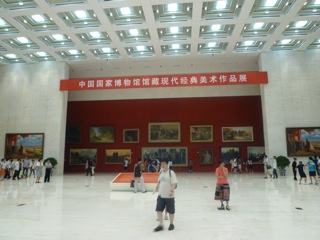
Few other visitors can be spotted strolling through the dimly lit rooms. The eyes have to re-adjust to the bright daylight in the lobby of the colossal modern glass and steel structure of the building, which is a merger of the former Chinese Revolutionary Museum and the Chinese History Museum. On this Saturday morning, the crowds are headed towards the hall facing the main entrance. Its walls are painted bright red, large oil canvasses depict Mao Tse-tung in commanding poses and conspiratorial meetings of early Communist groups in Hunan – a special exhibition to celebrate the 90th anniversary of the Chinese Communist party.

Image

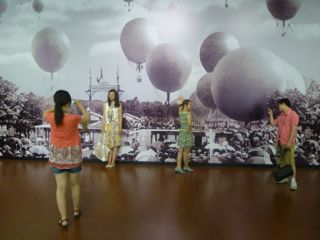
The biggest attraction, however, awaits the visitors on the far right side of the building: A huge pink screen announces the exhibition about the “Voyages” of Louis Vuitton. In four big halls, it tells the story of the founder of the French luxury brand who started out as a luggage packer for Parisian high-society ladies in the mid-19th century. The company also equipped explorers with sturdy trunks, among them the members of an expedition from Paris to Peking in 1907 or the members of the 1931 Croisiere Jaune, who followed Marco Polo’s route to China.

Image

Growing up in Germany, I had thought of Louis Vuitton as the world’s least subtle fashion brand, the status symbol of choice for middle-aged wives of small town lawyers and doctors. But in today’s China (and all over Asia), “Luyi Weideng” (short: LV) symbolizes youth and glamour. Fashionably dressed and fashionably slim young ladies saunter between the glass showcases and examine the old models of travel bags and trunks with an expert’s eye. The new models need no introduction – they are suspended from the shoulders of the visitors.

The juxtaposition of Chairman Mao and LV has led Chinese media to debate if materialism has taken over as the leading ideology in today’s China. One might add: Just like Communism once superseded the ideas of the European Enlightenment, introduced to China by reformers in the early 20th century. The National Museum has thus captured three stages of China’s development in the last 100 years. For a motto, I would suggest: 启蒙,起来,发财!(Qimeng, qilai, facai!) : Wake up (from ignorance), stand up (for the revolution) – and get rich!

Posted in Letter from China | Leave a comment

Letter from China (3): Food from the Provinces

If my first two days in Sanlitun had made me wonder whether they still offer Chinese food in China, I should not have worried. But things have certainly gotten more sophisticated – and gone way beyond Peking duck! On my first night out with a Chinese friend, I am introduced to one of the fanciest Yunnan restaurants in town. Its name, 一座一望, suggests that once you sit down on one of those elegant wooden benches between palm trees, you forget everything that is cumbersome in your life.  The Yunnan cuisine knows an abundance of wild herbs, mushrooms and edible flowers, which turns every meal into an aesthetically pleasing experience.

The taste of the tropical Southwest is the latest wave in the often grey and dreary-looking Chinese capital. “Have you tried 中8樓 in Sanlitun?”, asks another friend, an exiled Beijinger, via email from Washington, DC. According to the city magazines, that place has the best “Yunnan fusion food”. The owner of 小雲南 (Little Yunnan) on the other hand keeps it authentic. His tiny place is located in a traditional Chinese courtyard house – the perfect setting for a warm summer night.  Apart from the obligatory Boletus mushrooms (a version of the good old German Steinpilz), the menu reminds of Yunnan’s vicinity to Tibet, offering deep-fried goat milk in several variations. I need a lot of rice wine to neutralize the flavor.

A few days later, someone suggests to have dinner at the Guizhou Dasha. The big Guizhou building? Guizhou is another Southwestern Chinese province, it shares borders with Yunnan and Hunan and therefore Yunnan’s preference for exotic herbs and Hunan’s for red hot chili peppers. When I meet my contact at the agreed address, we are facing a multi-storeyed building which has been gutted to its frame. Workers tell us that it is being renovated. „Come back in three months.“ We can’t wait for so long, so we drive down the street looking for alternatives. Why not the Anhui Dasha?

At last, I find out what the secret of those buildings is. They are the „hotels“ of the Chinese provinces in Beijing, similar to the embassies of the German federal states in Berlin. In Germany, those „Landesvertretungen“ treat their guests to regional specialties at their annual receptions – and invitations to the embassies of Baden-Württemberg and Bavaria are usually the most sought after. In Beijing, as it turns out, provincial officials stay in those embassy hotels when they visit the capital. And most of those places have restaurants that are open to the public all year round!

This is how I get to try food from Anhui. Anhui is a province in central China, famous for the Yellow Mountain in the South and poor peasants in the North, but not for its cuisine.  The restaurant still has that certain Communist touch: big round tables, neon lights and slow waiters. We order a „stinky mandarine fish“ 臭鮭魚, which tastes a lot better than its name suggests. We eat a version of jiaozi, the Chinese dumplings, which are not wrapped in dough, but in paper-thin tofu.  The highlight is a hearty stew named after the famous intellectual Hu Shi, the father of Chinese liberalism in the early 20th century – and a native of Anhui. The dish is a delicious mix of deep-fried tofu, quail eggs, chicken and ham.

On the way home, my stomach feels full and lazy, but my mind is already busy speculating what people might eat in Henan and Hebei, in Heilongjiang or in Ningxia? I have to find out where their embassy hotels are. Who knew that one could visit all of China’s more than 30 provinces and regions without leaving Beijing?

Posted in Letter from China | Leave a comment

Letter from China (2): Sanlitun, New and Old

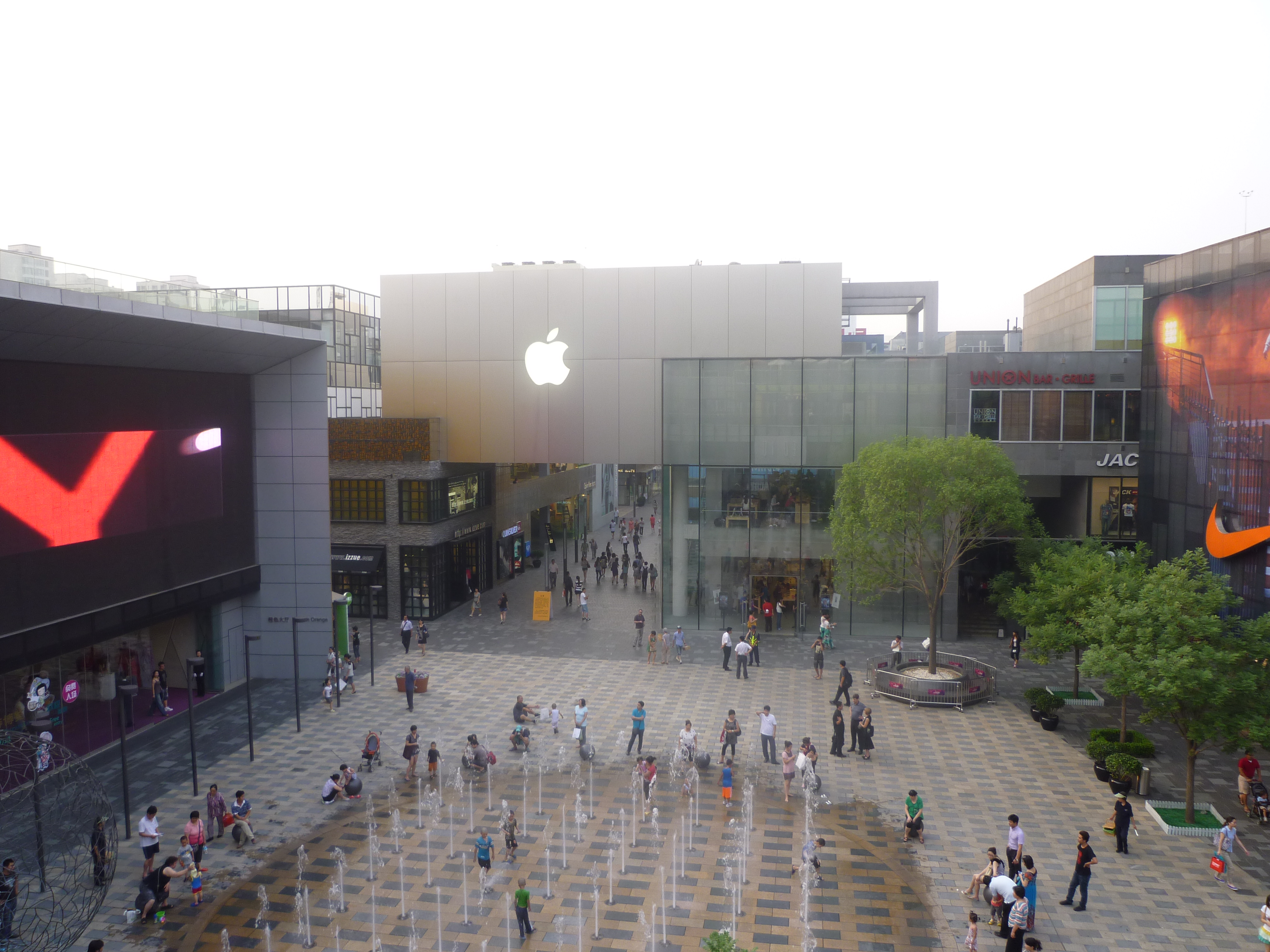
“Let’s meet in Sanlitun,” my friends suggest. This should be easy, I had lived in that area during a previous stay in Beijing. The plan is to spend an all-American evening, the day of my arrival after all is July 4th – and we are meeting at a place called Union Bar and Grill. This sounds normal: Sanlitun has always been a central nightlife location for foreigners in Beijing. But when I get there I can’t believe my eyes.Image

Of course, I have heard that the area has become “more upscale” lately, and I remember when the first bulldozers came in 2005 to tear down the row of bars that used to line this street.  Now is my chance to see what “upscale” means in today’s China: “Sanlitun Village” is a Singapore style labyrinth restaurants and flagship stores of all the major global brands. I climb to the third floor of the shiny black Adidas cube to take in the scenery: An artificial square framed by a huge video screen and more stores on each of the other three sides. On the opposite side of the skywalk, I spot the sign for Union Bar and Grill.

This is what progress looks like, I suppose, but I am still a little sad when I think of the “Bar Street” of the past. I would like to find out which of the side streets and old places I used to know still exist. My chance for this comes sooner than expected. “Let’s meet for lunch in Sanlitun,” another friend suggests the following day.

After a light French lunch, I decide to stroll through the neighborhood. I am looking for a Chinese phone card, but I am also searching for a lost world. I walk past a huge Reiss London store (the chain that just closed in Georgetown because they could no longer afford the rent), past Armani and Jean-Paul Balmain. And then I leave the fenced-off area of the “village”, diving into a smelly, dirty Beijing back street, where groups of old men sit on little stools and drink tea out of greasy glas jars. I take a deep breath. There, in the background, I can see the Yashow department store. I walk over to check if they still sell all those fake Northface jackets and Burberry coats. Result positive. Some things never change.

Back to the phone card project. The first vendor charges 150 Yuan for a card that comes with a credit worth of 30. The second vendor offers the same card for 40 Yuan. I give him the money and break the SIM card out of its plastic frame. Then I notice that someone has already rubbed off the silver coating from the pin code. The kiosk owner assures me that this is not a problem.  I have my doubts, and when I dial the phone company’s number to pay the usage fee of five Yuan, the code is invalid. The vendor’s son tries it and comes back with more bad news: Not only is the pin code invalid, there also isn’t any credit on the card. The shop owner was duped by his supplier. He looks despondent as he hands me back my 40 yuan. Not only foreigners get cheated in China.

The woman in the next store knows how to win a customer’s trust. She inserts a brand new card into my phone and dials the company’s hotline to confirm the credit.  Having completed my mission, I decide that I need a cup of coffee at the Starbucks below the big video screen. Now I know that the old Sanlitun still exists. It is still possible to spend a whole afternoon trying to buy a phone card that is not a fake. Looking up at the shiny black Adidas store, I understand why people are willing to pay the real price for real things – and why they might actually like the new Sanlitun.

Posted in Letter from China | Leave a comment